

Al Mazrou’s Artistic Vision Transforms Rigid Materials into Fluid Forms.
Abu Dhabi: Emirati artist Shaikha Al Mazrou explores the relationship between water, landscape and the horizon through sculptures that challenge conventional perceptions of materials, movement and form.
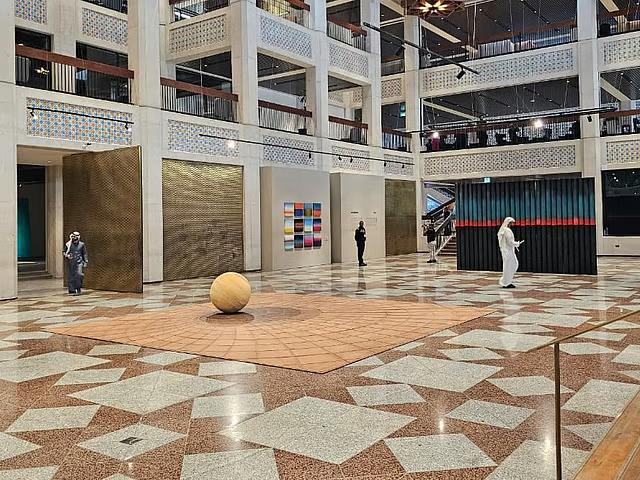
At Abu Dhabi’s Cultural Foundation, Two Horizons brings together a selection of significant works and new commissions by the artist, whose practice is defined by experimentation with materials such as steel, marble, glass, resin and copper.
“The horizon is never a straight line, but our eyes deceive us into believing it is,” Al Mazrou says, reflecting on her work.
This idea of perception and illusion runs throughout the exhibition. Through her exploration of materials and their possibilities, Al Mazrou translates ideas of water, landscape and the horizon into sculptural forms that invite viewers to reconsider what they see.
Standing among the artworks, I found myself slowing down, trying to make sense of the forms before me. There was something quietly absorbing about the experience, almost as though time had paused and I had, for a moment, become poetic myself.
A poem, but not a poem
At the centre of the exhibition’s atrium stands a work whose origins lie far from Abu Dhabi.
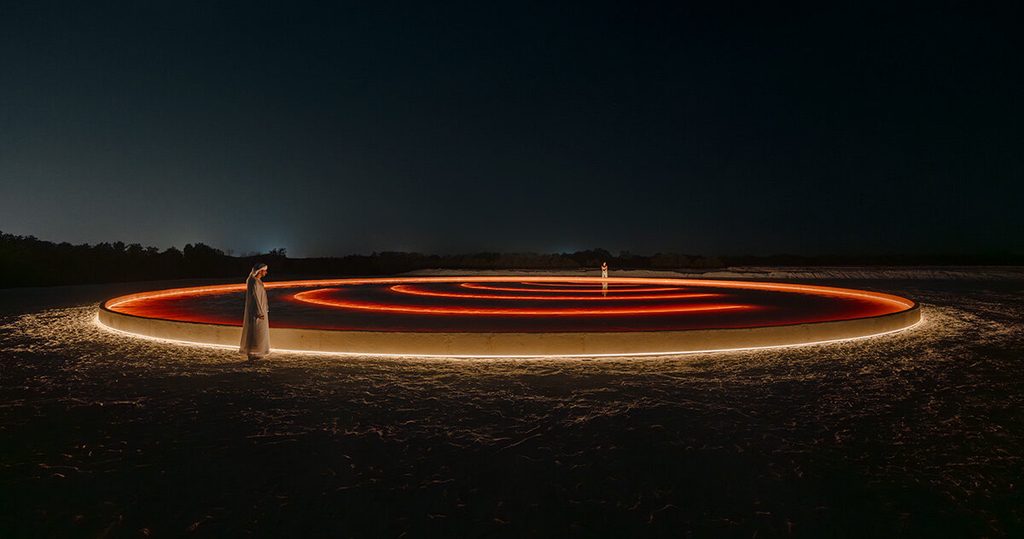
Al Mazrou initially created the piece for the Aichi Triennale in Japan. Without a specific location in mind, she explored different parts of Nagoya, moving between conventional gallery spaces and outdoor settings until one place caught her attention: a dried-up fountain outside a cultural institution. At the time, she was reading the French poet Stéphane Mallarmé, and the idea for the work eventually took shape in response to that particular setting.
Speaking on the sidelines of the exhibition, Al Mazrou explained the thinking behind the sculpture. Listening to her describe it, I found myself thinking of it as a work of poetry in its own right.
The piece draws its title from Mallarmé’s A Throw of the Dice Will Never Abolish Chance, a poem widely regarded as an important turning point in the way poetry is structured and read.
Carved from black jade marble, the sculpture appears from above as two ripples spreading across a surface.
“I always claim that I’m not a poet, and this is not a poem,” Al Mazrou says. “My work doesn’t necessarily reflect poetry, but it’s heavily influenced by poetry.”
For the artist, water represents both longing and uncertainty. She speaks of how poets have long drawn on water to express emotions through images of tides, currents and desire. Yet it also carries contemporary associations, including the journeys of refugees and immigrants.
“As much as I romanticize it, as much as it scares me,” she says, describing her complicated relationship with the element.
Even the colour of water, she suggests, is not as straightforward as it appears. “We say it’s blue, but it’s never blue. Water was always clear.”
Making rigid things move
For Al Mazrou, sculpture begins with an engagement with material. She is drawn to the contradictions within different substances and the possibilities that emerge when their familiar characteristics are challenged.
She takes marble, a dense and seemingly immovable stone extracted from mountains and cut using powerful water jets, and gives it the appearance of fluidity. Industrial metal, meanwhile, is folded and manipulated until it resembles something as delicate as paper.
The distinction between the two materials is particularly important to her.
“You can take a piece of paper and fold it as much as you want, but you can spread that paper back to its A4 size,” she says. “With metal, it does not obey you. You can fold it, and it holds its shape.”
It is this resistance that interests her. Unlike paper, metal retains the memory of its manipulation, making each fold a lasting intervention in the material.
Her experiments also extend to changing the surfaces of metals through oxidation. The resulting transformations introduce further layers of meaning, bringing together ideas of concealment, protection, restriction, permanence and impermanence.
Form, too, remains central to her practice. Cylinders, circles, grids and squares appear repeatedly across her sculptures. Yet Al Mazrou is reluctant to identify herself with any particular geometric language, suggesting that the forms emerge from the ideas and processes behind each individual work rather than from a fixed visual preference.
“I think through form,” she says. “These forms originate from words.” For Al Mazrou, the creative process begins when an idea or emotion calls for a visual language that has yet to take shape.
Metaphors in shapes
Some of Al Mazrou’s works carry subtle layers of metaphor. One particular piece, rendered in blue and marked with numbers, is titled Despite the Weather. It made me pause and take a second look. For a fleeting moment, I interpreted it as a commentary on the internet age, with its endless codes and the illusions they create.
Her explanation, however, offered a different perspective, one that carried a deeper meaning. The numbers in the work represent coordinates and telephone numbers, while also suggesting the countless possibilities of lives, journeys and places.
Al Mazrou describes the piece as metaphorical, conveying the idea that things will happen again, despite the weather. As with much of her practice, it touches on themes of perception, hope and belonging.
Lost in translation
Al Mazrou is equally open to the different ways audiences interpret her work. While accompanying texts and titles provide some context, she does not want them to determine what viewers should see or feel.
“The translation is constantly redefining and defining,” she says.
For her, the exhibition is not about arriving at definitive answers or resolving every question. Instead, her artistic practice remains an ongoing quest. She may expand an existing work, move away from an idea or return to something she created a decade earlier, approaching it with a renewed perspective.
“Maybe you would say it’s not a horizon, and this is where conversation falls into a dialogue,” she says.
What she hopes visitors carry with them is “a bit of that landscape” – an impression that remains open to interpretation, long after they have left the exhibition.
Learning through practice
As she continues to evolve as an artist, Al Mazrou reflects on the beginnings of her journey. Today, she teaches at New York University Abu Dhabi, but her relationship with art began much earlier, when she was a student at the University of Sharjah.
As a teenager, she had aspirations of becoming an architect. That early interest continues to influence her practice, where she frequently explores the intersections of language, architecture and sculpture. She describes her way of thinking as that of “a poet, an architect and an artist”.
Her artistic journey, she says, truly began during her undergraduate years, when she immersed herself in art history, media theory, Islamic and South Asian art, and cinema.
“I am still hungry to learn,” she says.
That willingness to learn also comes from embracing what does not work. For Al Mazrou, failure is not something to avoid but an essential part of the creative process.
“I love failure,” she says. “I’ve only learned from failure.”
When a line of poetry fails to find its expression in a particular sculpture, she returns to the text, reads it again and attempts to translate it through another medium. It is this willingness to reconsider, reinterpret and begin again that allows her artistic practice to keep evolving.
Two Horizons
Curated by Reem Fadda, Director of Culture Programming at the Department of Culture and Tourism – Abu Dhabi, the exhibition is co-curated with Noor AlMehairbi, Curator at the Cultural Foundation, and Paz Monge, Head of Exhibitions at the Cultural Foundation. Afra Saif Almazrouei serves as Assistant Curator.
Considered among the most dynamic artists of her generation in the UAE, Al Mazrou is an Assistant Professor of Arts Practice at New York University Abu Dhabi.
Running until 18 July 2027 at the Cultural Foundation in Abu Dhabi, Two Horizons invites visitors to reconsider the boundaries between materials and movement, language and form, and the familiar and the unfamiliar.
As I walked away, I found myself thinking less about what each sculpture was meant to represent and more about what it had made me feel. Perhaps that is the beauty of Al Mazrou’s horizons: they do not offer a fixed destination or a single interpretation, but leave room for curiosity, imagination and the possibility of seeing the world differently.

