

Four Emirati experts develop platform that reduces toxicology testing time to seconds.
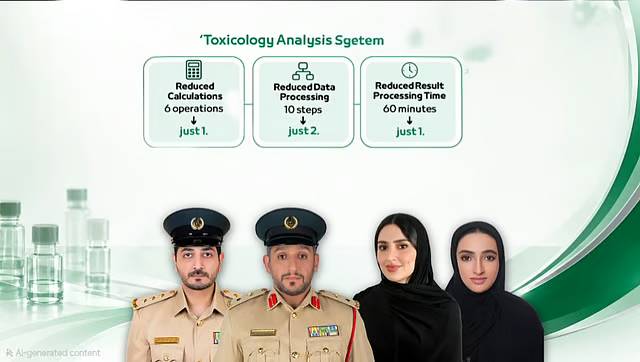
Dubai: Dubai Police has reduced forensic toxicology processing time from around 60 minutes to less than a minute using a new smart system that automates laboratory calculations and data analysis, accelerating forensic examinations.
Developed by four Emirati experts from the force’s General Department of Forensic Science and Criminology, the digital platform brings laboratory data, scientific references, calculations and preliminary comparisons together in one integrated system. It reduces manual work while improving consistency and operational efficiency.
The system cuts data-processing steps from 10 to two and replaces six separate calculation procedures with a single automated operation. This allows forensic specialists to spend less time on routine tasks and more time analysing results.
The project was led by Lieutenant Colonel Dr Expert Rashid Humaid Al Rumaithi, alongside Captain Engineer Expert Mohammad Abdul Qader Al Shamsi and forensic toxicology experts Marwa Aqeel Al Janahi and Fatima Ali Al Suwaidi.
Replacing lengthy manual procedures
Lieutenant Colonel Dr Al Rumaithi, the project director, said the system was developed to address technical and operational challenges associated with conventional forensic toxicology examinations.
Previously, specialists had to carry out several tasks manually, including transferring laboratory data, performing calculations, checking results and comparing findings against scientific references. The process was time-consuming and could also result in variations in working methods.
“The project transforms forensic toxicology analysis from a series of separate procedures involving files, spreadsheets and manual calculations into one integrated digital process,” he said.
The platform automatically reads laboratory data, performs the required calculations, links results to scientific references and helps specialists compare and interpret findings.
However, it does not replace expert judgement. Specialists remain responsible for reviewing and verifying the results before issuing their final technical opinions.
Experts focus on analysis, not calculations
Captain Engineer Expert Al Shamsi said the innovation goes beyond automating calculations, as it reorganises the entire workflow around a unified institutional methodology.
Previously, toxicology specialists spent considerable time organising data and carrying out manual calculations before they could begin interpreting the findings.
The new platform completes calculations, organises data and conducts preliminary comparisons in less than a minute. This allows specialists to focus on analysis, interpretation and approving the final technical opinion.
He described the platform as a smart assistant that supports forensic experts rather than replacing their role.
He stressed that specialists must continue to assess findings in the context of each case, taking into account the sample, the substance involved, the surrounding circumstances and the forensic significance of the results before reaching a final professional conclusion.
Processing time cut from 60 minutes to less than a minute
Forensic expert Fatima Al Suwaidi said the traditional process involved several stages, from transferring laboratory data and performing calculations to consulting scientific references and preparing final reports.
The new system has significantly reduced the time and effort required at each stage.
Results processing time has fallen from approximately 60 minutes to less than a minute, while the number of data-processing steps has been reduced from 10 to two.
The six separate calculation operations previously required have also been combined into a single automated process. Meanwhile, the time taken to prepare outputs has dropped from an average of 30 minutes to just one minute.
Al Suwaidi said the improvements had reduced repetitive work and enabled specialists to complete their tasks more efficiently while maintaining accuracy.
Forensic toxicology expert Marwa Al Janahi said the platform marked an important step towards applying smart technologies to specialised forensic work.
She explained that reducing manual intervention and standardising procedures strengthened the reliability of results, allowing specialists to devote more time to complex scientific examinations instead of repetitive calculations and administrative tasks.
AI integration among future plans
Dubai Police plans to expand the platform’s capabilities through closer integration with laboratory instruments, reducing the need for manual data entry.
Future development will also focus on updating scientific databases and reference resources, as well as introducing performance indicators and knowledge dashboards to support operational planning and decision-making.
The team will also explore the use of artificial intelligence and smart assistants to help specialists retrieve relevant scientific information more quickly.
The project forms part of Dubai Police’s wider efforts to promote institutional innovation and adopt advanced digital solutions. It aims to strengthen forensic laboratory readiness, improve the quality of technical services and accelerate case processing without compromising accuracy or reliability.

