

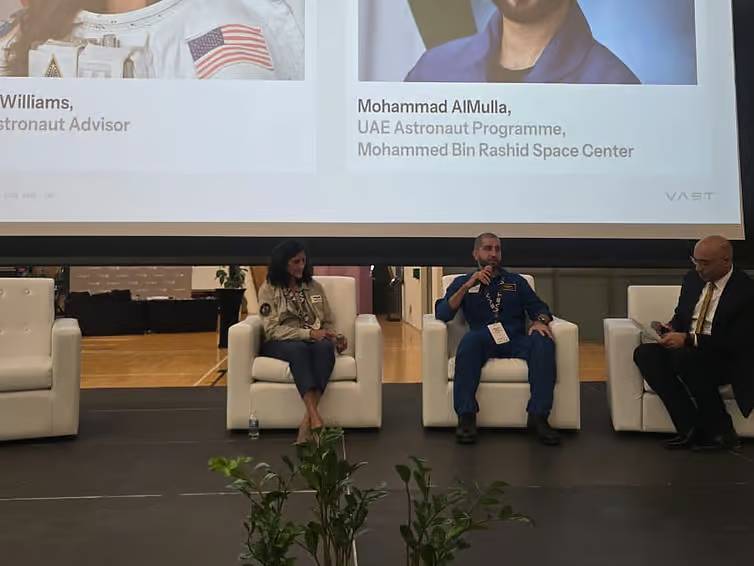
Emirati astronaut Mohammad Al Mulla highlights 3D bioprinting in microgravity as a potential future breakthrough, while former NASA astronaut Sunita Williams says commercial space stations could expand biological research.
Scientists are exploring whether printing organs in space could one day help address the shortage of donor organs for transplant patients, as research continues into how microgravity affects the production of biological materials.
Emirati astronaut Mohammad Al Mulla has highlighted the potential of 3D bioprinting in space, suggesting that the technology could eventually help produce structures such as hearts and knees.
He explained that gravity influences how materials are deposited layer by layer on Earth, while microgravity could allow researchers to investigate new ways of building complex biological structures.
Al Mulla pointed to the demand for donor organs, including hearts, lungs, livers and kidneys, as a key reason to explore the technology. However, printing fully functional organs suitable for transplantation remains a future possibility, with no confirmed timeline for achieving it.
Speaking at an event hosted by Masdar City and space company Vast in Abu Dhabi on Tuesday, Al Mulla expressed hope that the technology could eventually be used to produce organs or other biological structures needed by patients.
Research into bioprinting tissues in orbit is already under way. NASA has reported experiments involving bioprinted cartilage aboard the International Space Station (ISS), including research into human knee meniscus tissue. Scientists are investigating whether microgravity could help produce tissues with properties that may eventually support new medical treatments.
Commercial space stations could expand biological research
Former NASA astronaut Sunita Williams said commercial space stations could help advance biological research by enabling scientists to move beyond individual experiments towards more automated processes.
During her space missions, Williams worked on experiments involving stem cells, DNA sequencing and capillary flow. She said researchers had developed ways to adapt equipment and procedures to the unique conditions of space, creating opportunities for more automated scientific work.
Williams noted that manually conducting experiments could limit the amount of research completed in orbit.
“I was doing the work by hand in the glove box… it’s one plate at a time, and it takes a half a day to do that,” she said.
Greater automation could allow researchers to grow stem cells and organoids — small, simplified models of organs made from cells — more efficiently. This could potentially make it possible to produce biological materials in orbit and return them to Earth for further study.
While space-based organ printing remains an emerging field, researchers hope that advances in bioprinting, automation and commercial space infrastructure could open new possibilities for medical research and, eventually, transplant medicine.
Williams said the International Space Station (ISS) had laid the groundwork for this research, but commercial space stations could provide a more efficient environment for repeatable experiments and large-scale biological studies.
She also described how microgravity affects everyday activities in space. Objects do not remain where they are placed, forcing astronauts to secure equipment and personal belongings with tethers or Velcro to prevent them from floating away.
“You lose everything up in space,” she said.
Liquids present another challenge. Without gravity, fluids behave differently, moving along surfaces and through equipment in unexpected ways that can complicate experiments and routine tasks.
Williams illustrated the difficulties with a photograph of a birthday cake prepared for an astronaut, with peanut butter used to keep it attached to the plate.
Williams, who retired from NASA in 2025 and now serves as an astronaut adviser to Vast, said commercial space operators would play an increasingly important role in the next phase of activity in low-Earth orbit. She highlighted the potential for research conducted in space to deliver practical benefits on Earth.
For now, producing transplant-ready organs in space remains a long-term research goal rather than an imminent medical breakthrough. However, the discussion highlighted growing interest in how advances in bioprinting, automation and commercial space infrastructure could eventually expand the possibilities for medical science.
Al Mulla, who has yet to travel to space, said he looked forward to the opportunity after years of astronaut training.

