

As Parents Rush to Drop Off Children, School Buses and Pedestrians Add to Traffic, Making Road Safety More Critical.
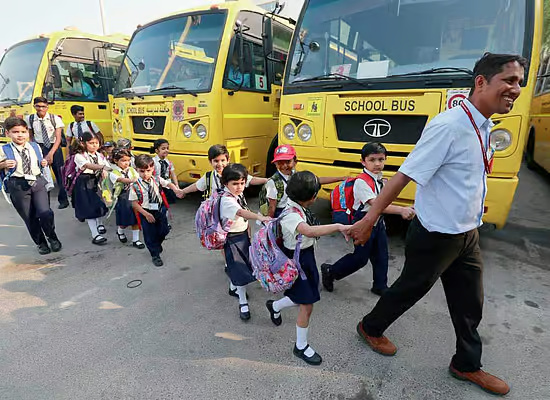
As students return to classrooms across the UAE, roads around schools are expected to become increasingly busy during morning drop-off and afternoon pick-up periods.
With parents dropping off children, school buses arriving and departing, and pupils crossing roads and entering school premises, even minor traffic violations can lead to congestion and raise safety concerns. Drivers are advised to plan their journeys, set out early and follow traffic rules carefully in school zones.
Here are 10 common traffic mistakes motorists should avoid during the UAE back-to-school rush.
1. Failing to Stop for a School Bus
When a school bus stops and extends its Stop arm to allow pupils to board or leave, approaching drivers must stop and wait until the process is complete and it is safe to proceed.
Some motorists may assume they have enough room to pass the bus, particularly when they are in a hurry. However, children may be getting off the bus or preparing to cross the road, making their movements difficult to predict.
Drivers should slow down as soon as they see a school bus stopping and remain stationary while the Stop arm is extended. Giving pupils a few extra seconds to board or leave the bus can help prevent accidents and keep the area clear.
Failing to stop for a school bus can result in a Dh1,000 fine and 10 black points.
2. Speeding Around Schools
Speeding near schools leaves drivers with less time to react when a child suddenly crosses the road, a school bus stops or another vehicle slows to drop off a pupil.
Many school zones have lower speed limits, so motorists should follow the posted signs rather than assume the usual limit applies. Drivers rushing to drop off children may also fail to notice when they enter a reduced-speed area.
Even when the road appears clear, children can suddenly cross or emerge from between vehicles. Motorists should therefore reduce their speed and remain alert.
Speeding fines depend on how far the driver exceeds the posted limit, ranging from Dh300 to Dh3,000 for more serious violations.
3. Using a Mobile Phone or Driving While Distracted
Checking a message, answering a call or adjusting navigation while driving can take a driver’s attention away from the road at a critical moment.
School zones require particular vigilance. A distracted driver may fail to notice a child approaching a crossing, a school bus stopping or another vehicle braking suddenly.
Motorists should put their phones away and remain focused throughout the journey, especially when approaching schools.
Using a mobile phone while driving can result in a Dh800 fine and four black points.
4. Failing to Give Way to Pupils and Pedestrians
Pedestrian crossings near schools can become especially busy during drop-off and pick-up times, with pupils and parents often crossing in groups.
Drivers should slow down when approaching a designated crossing and give pedestrians enough time to cross safely. Trying to pass before a child reaches the other side can leave little room to react if they stop, change direction or are followed by another pupil.
Giving pedestrians a few extra seconds can significantly improve safety around school zones.
Failing to give way to pedestrians can result in a Dh500 fine and six black points.
5. Stopping on a Pedestrian Crossing
Stopping on a pedestrian crossing to drop off a child may seem convenient when traffic outside the school is heavy, but it can create serious safety problems.
A vehicle blocking the crossing can force pupils to walk around it or between other cars, while also making it harder for approaching drivers to see children.
With large numbers of pupils and parents using crossings during school hours, motorists should keep these areas completely clear.
6. Stopping in the Middle of the Road
Stopping in a traffic lane to drop off or collect a child is a common source of congestion around schools, particularly during morning and afternoon peaks.
When a vehicle stops in the road, other motorists may have to brake, change lanes or drive around it. Children may also move between vehicles as they make their way to the school entrance or a waiting bus.
Although a parent may intend to stop for only a minute, several vehicles doing the same can quickly make the road congested and unpredictable. It can also prevent school buses from pulling in and leaving safely.
7. Not Wearing Seat Belts
Some parents may overlook seat belts when the school is only a few minutes away, particularly when they are running late. But short journeys can still involve sudden stops, lane changes or unexpected hazards.
Children should be properly secured throughout every journey, whether they are sitting in the front or rear of the vehicle.
All passengers are required to wear seat belts. Failing to do so can result in a Dh400 fine and four black points.
8. Child-Restraint and Front-Seat Violations
Parents should ensure children are properly secured even on short school runs. Children under 10 years old, or those shorter than 145cm, should not sit in the front seat, while young children must use an appropriate child-restraint system.
Before setting off, parents should check that children are seated correctly and securely fastened.
Violating child-restraint requirements can result in a Dh400 fine and four black points.
9. Parking Behind Another Vehicle
Finding a parking space outside a busy school can be challenging, but stopping behind another vehicle and blocking it can create further delays.
A parent may leave the car briefly to take a child inside, only to prevent another motorist from leaving. Such parking can quickly add to congestion and cause unnecessary disruption during already busy school hours.
10. Improper Parking
Improper parking can worsen congestion around schools and restrict access for pupils, parents, school staff and emergency vehicles.
Motorists should avoid parking near school entrances, blocking exits, obstructing pedestrian routes or leaving vehicles in areas that need to remain clear.
Keeping designated access points and pedestrian areas unobstructed can help traffic move more smoothly and make school zones safer for everyone.

