

Electric Aviation Reaches a Major Milestone, Advancing from Small Demonstrators Toward Full-Scale Airliners.

The world’s largest battery-electric aircraft, weighing 11 tonnes, has taken to the skies, completing a 27-minute test flight using just around $5 worth of electricity.
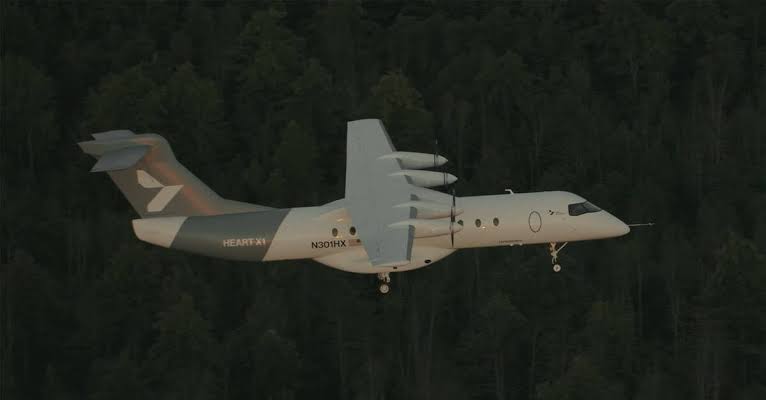
Sweden-founded, US-based Heart Aerospace conducted the maiden flight of its full-scale X1 demonstrator on August 12, 2026, at Plattsburgh International Airport in New York.
The aircraft remained airborne for 27 minutes, reaching an altitude of 335 metres (1,100 feet). It was powered entirely by a battery-electric propulsion system capable of delivering more than 1 MW.
Key Figures
- 27 minutes — duration of the aircraft’s maiden flight
- 335 metres (1,100 ft) — peak altitude reached during the test
- $5 — estimated cost of electricity for the demonstration flight
- 106 ft (32 m) — aircraft wingspan
- More than 25,000 lb (11,340 kg / 11.3 tonnes) — take-off weight
- More than 1 MW — electric propulsion power generated by the battery system
- 4 electric motors — wing-mounted propulsion system
- 30 seats — target passenger capacity of the future ES-30
- 200 km — planned all-electric range of the ES-30
- 800 km — planned hybrid-electric range
- 30 minutes — targeted charging time
Plan: 30-Seat Commercial Aircraft
The X1 is not the company’s intended 30-seat passenger aircraft. Instead, it serves as a full-scale technology demonstrator, allowing Heart Aerospace to test the technologies, systems and manufacturing processes that will underpin its planned ES-30 regional aircraft.
The ES-30 is a hybrid-electric aircraft rather than a fully electric one. According to Heart Aerospace, it is designed to fly approximately 200 km on battery power alone, while its hybrid-electric configuration could extend its range to as much as 800 km.
The ES-30 is the planned 30-passenger aircraft, designed to offer around 200 km of all-electric range. The X1, meanwhile, is a full-scale demonstrator platform built to validate the technology and systems behind the future aircraft.
What Does the $5 Really Mean?
The $5 figure represents the estimated cost of the electricity consumed during the 27-minute experimental flight. It highlights the potentially low energy cost of battery-electric flight, but it does not represent the total cost of operating or maintaining the aircraft.
The $5 figure covers only the electricity consumed during the test flight. It does not account for pilots, maintenance, airport fees, battery depreciation or replacement, aircraft financing, insurance, or other airline operating expenses.
In other words, $5 was the electricity bill for the demonstration flight—not the total cost of operating the aircraft.
Development Timeline
2019 — Heart Aerospace Founded
Heart Aerospace joined Y Combinator’s W19 programme, marking the beginning of its work on electric regional aircraft.
2020 — Early ES Regional Aircraft Revealed
The company unveiled its early ES-19 concept, attracting growing interest from airlines, investors, and the wider aviation industry.
July 2021 — $35 Million Series A
Heart Aerospace raised $35 million in Series A funding, led by Breakthrough Energy Ventures, with strategic investments from United Airlines and Mesa Air Group.
December 2021 — First Subscale Flight
A smaller-scale demonstrator completed its first flight, helping Heart validate the electric propulsion system and key flight characteristics of its aircraft concept.
September 2022 — ES-30 Unveiled
Heart Aerospace moved beyond the ES-19 concept and introduced the 30-seat ES-30, its planned production regional aircraft.
February 2024 — $107 Million Series B
Heart raised $107 million in Series B funding to support development of the X1 technology demonstrator and accelerate the ES-30 programme.
September 2024 — X1 Unveiled
Heart Aerospace unveiled its full-scale X1 technology demonstrator, a 32-metre aircraft built specifically to test and validate technologies intended for the ES-30.
October 2024 — Ground Testing Begins
The X1 underwent a series of ground tests, including servicing, battery charging, taxiing and turnaround operations. These trials were important for developing the new airport and charging procedures required for electric aircraft.
January 2025 — US Flight-Test Base Established
Heart Aerospace established its X1 flight-test base in Plattsburgh, New York, preparing the aircraft for its upcoming flight-test campaign.
October 2025 — Pilot Manufacturing Plant Opens
Heart’s Los Angeles Pilot Plant became operational, supporting manufacturing development and helping prepare the company for future aircraft production.
July 2026 — FAA Clearance
The FAA issued a Special Airworthiness Certificate for the X1, clearing the way for Heart Aerospace to begin its flight-test campaign.
August 12, 2026 — Historic First Flight
The X1 completed its maiden flight, becoming the largest battery-electric aircraft to fly to date. The aircraft remained airborne for 27 minutes and reached an altitude of 335 metres (1,100 feet).
2028 — Next Major Test Phase
Heart Aerospace plans to begin flight testing of the pre-production ES-30/X2 programme, bringing the technology a step closer to a production-ready aircraft.
2031 — Targeted Entry Into Service
Heart currently targets 2031 for the ES-30’s entry into service and type certification, subject to the progress of development and regulatory approval.
Why This Matters
The X1 is not yet an electric replacement for large commercial aircraft from Airbus or Boeing. Its significance lies in the regional aviation market.
Heart Aerospace is targeting short-haul routes where a 30-seat aircraft could connect smaller cities and regional airports using zero-emission electric propulsion on shorter flights, while its hybrid-electric system could enable substantially longer journeys.
The bigger milestone is the scale of the aircraft that has now taken flight. With a weight of more than 11 tonnes, a 32-metre wingspan, and megawatt-class electric propulsion, the X1 is providing real-world flight data that could help determine whether battery-electric technology can be scaled into a commercially viable regional aircraft.

