

How the Dubai Metro Blue Line will redefine routes and support future expansion.
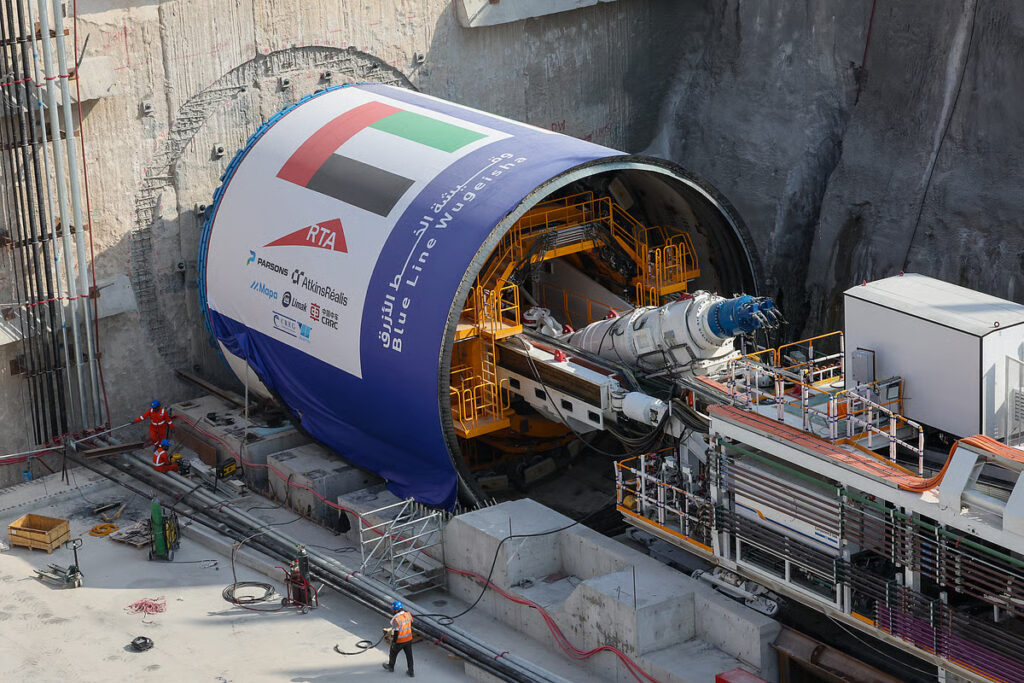
Dubai: The long-awaited Dubai Metro Blue Line is moving closer to reality, with major construction milestones achieved as work progresses on one of the emirate’s most important transport infrastructure projects.
Only two months after tunnelling operations officially began, the Roads and Transport Authority (RTA) announced the completion of the first excavation phase in July, highlighting the advances in construction technology since Dubai’s original Metro network was launched nearly two decades ago.
The Blue Line forms a central part of Dubai’s long-term urban development strategy, aimed at connecting growing residential areas, business hubs, and major destinations while supporting the objectives of the Dubai 2040 Urban Master Plan.
Faster tunnelling than ever before
The start of tunnelling operations marked a major milestone in the development of the Dubai Metro Blue Line, while also highlighting the significant evolution of construction capabilities since the city’s first Metro tunnels were built in 2007.
At the time, tunnel boring machines represented a major engineering achievement, with excavation progressing at an average rate of around 12 metres per day. Completing the tunnelling phase required approximately seven months.
Today, the Blue Line is being excavated using Al Wugeisha, a next-generation tunnel boring machine fitted with advanced digital guidance and monitoring technologies. According to the Roads and Transport Authority (RTA), the machine can excavate approximately 30 metres of tunnel per day — more than twice the pace achieved during the construction of Dubai’s original Metro network.
This improved capability has accelerated progress, with the first phase of tunnelling completed within just two months.
Measuring 163 metres in length and weighing around 2,000 tonnes, Al Wugeisha goes beyond a traditional tunnel boring machine. It functions as a fully integrated underground construction system, capable of excavating, removing excavated material, and automatically installing tunnel lining segments through a continuous process. The technology delivers greater accuracy, efficiency, and safety while helping to reduce overall construction timelines.
For Dubai, the milestone reflects the rapid advancement of the emirate’s tunnelling capabilities in less than two decades and highlights the role of technology in delivering major infrastructure projects.
Two landmark stations
Record-sized interchange station
At Dubai International City 1, the Blue Line will feature what is expected to become the largest underground interchange station in Dubai’s Metro network. Spanning more than 44,000 square metres, the facility has been designed to handle an estimated 350,000 passengers daily.
Serving as a central connection point for the entire line, the interchange will link the Blue Line’s two branches while improving connectivity between eastern and northern areas of Dubai.
World’s tallest Metro station
The project will also include Emaar Properties Station, which at 74 metres in height is set to become the world’s tallest Metro station. Designed by Skidmore, Owings & Merrill — the firm behind landmarks including Burj Khalifa — the station will cover approximately 11,000 square metres.
Beyond its transport role, the station has been designed as a landmark gateway reflecting Dubai’s modern identity and open urban character. It will primarily serve Dubai Creek Harbour, a waterfront development expected to accommodate around 40,000 residents, with daily ridership projected to exceed 70,000 passengers by 2040. The station will have capacity to serve up to 160,000 passengers.
Dubai Metro Blue Line routes
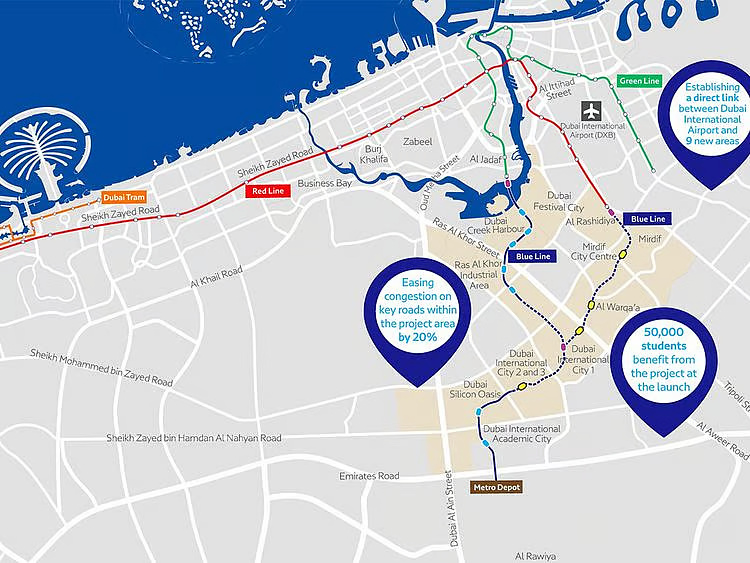
The Blue Line will extend 30 kilometres across two routes, improving connections between several fast-growing districts and supporting Dubai’s expanding urban development.
The first route will span 21 kilometres and include 10 stations, starting from Creek Interchange Station on the Green Line in Al Jaddaf. It will connect key areas including Dubai Festival City, Dubai Creek Harbour, Ras Al Khor Industrial Area, International City 1, International City 2 and 3, Dubai Silicon Oasis, and Dubai Academic City.
The second route will cover nine kilometres, beginning at Centrepoint Interchange Station on the Red Line in Al Rashidiya. It will pass through Mirdif and Al Warqa’a before linking with the International City 1 interchange station. This section of the Blue Line will feature four stations.
Looking ahead to the Blue Line’s completion
While the Blue Line remains under construction, the speed and scale of progress reflect the ambition behind Dubai’s next major transport expansion. Combining advanced tunnelling technology, landmark station designs, and enhanced connectivity, the project is set to become one of the most significant additions to the city’s public transport network since the Metro launched in 2009.

