

As Hormuz disruptions threaten energy flows, GCC states ramp up billion-dollar investments in alternative export routes.
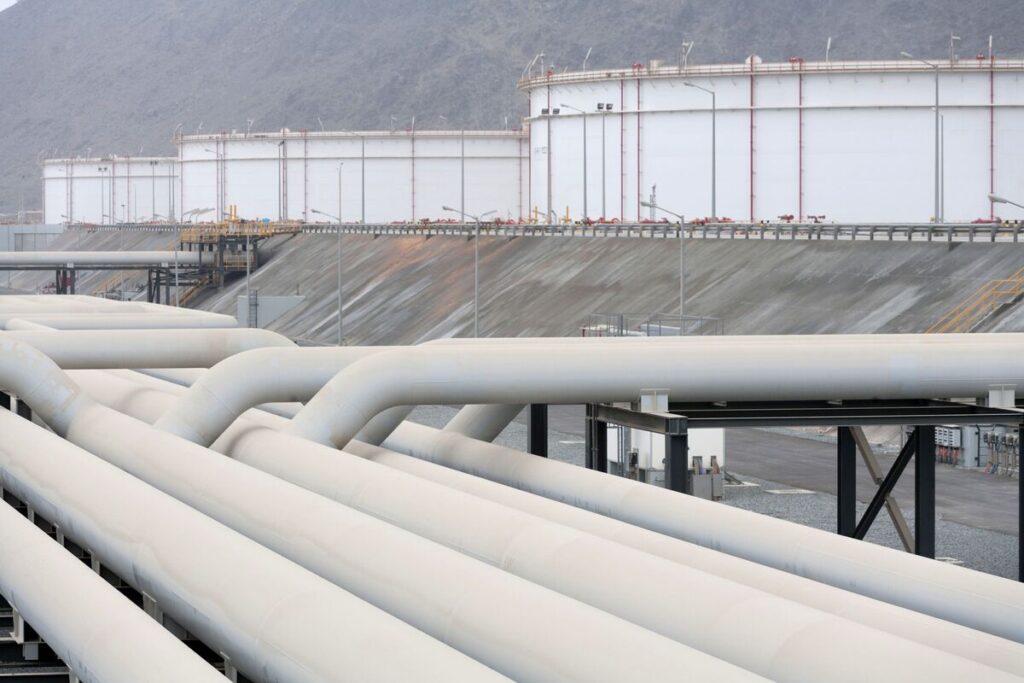
Dubai: Gulf countries are stepping up efforts to route oil exports around the Strait of Hormuz, as global institutions caution that any prolonged disruption to traffic through the strategic chokepoint could jeopardize energy security, slow economic growth, and disrupt food supply chains worldwide.
Among the main beneficiaries of this shift is Fujairah, the UAE’s strategic energy hub on the east coast. Located outside the Strait of Hormuz, the emirate has become a critical pillar of the Gulf’s efforts to safeguard oil exports and diversify shipping routes.
Record inventory drawdowns
Meanwhile, the heads of the International Monetary Fund, World Bank and International Energy Agency warned on Friday that global oil inventories were being depleted at a record pace, as markets reacted to a significant loss of crude supplies transiting through the Strait of Hormuz.
“If shipping flows do not return to normal, the continued rapid drawdown of global oil inventories ahead of the Northern Hemisphere’s peak summer demand season could heighten risks to fuel security, market stability and broader economic resilience,” the agencies said in a joint statement.
The warning comes as Gulf oil producers intensify efforts to reduce their reliance on the Strait of Hormuz, pursuing long-term export alternatives to one of the world’s most critical energy chokepoints, through which roughly one-fifth of global oil and fuel supplies are transported.
“The focus has shifted from oil supply concerns to the growing urgency of reducing reliance on the Strait of Hormuz,” said Stephen Innes, managing partner at SPI Asset Management.
Long-term strategy
The U.S.-Israel conflict with Iran has transformed what was once considered a geopolitical risk into a direct challenge for global energy logistics, exposing the vulnerability of supply chains that depend heavily on the Strait of Hormuz. Shipping through the waterway has been severely disrupted, prompting widespread rerouting and raising concerns about the reliability of one of the world’s most critical trade corridors.
Iran’s retaliatory actions against U.S. and allied interests have intensified those concerns, disrupting maritime traffic and increasing costs for shippers and insurers. With roughly one-fifth of global oil supplies normally passing through Hormuz, the disruption has reinforced the urgency for Gulf producers to develop alternative export routes and strengthen energy resilience.
As a result, countries across the Gulf are accelerating investments in pipelines, storage facilities and ports outside the strait, reflecting a broader strategic shift toward reducing dependence on a single maritime chokepoint.
Building a ‘Plan B’
While the Strait of Hormuz remains open, the conflict has underscored the risks of routing such a significant share of global oil exports through a single maritime chokepoint.
Analysts say Gulf governments are increasingly viewing that vulnerability as a long-term strategic challenge rather than a temporary consequence of wartime tensions. “What started as a military conflict is rapidly evolving into an infrastructure story,” said Stephen Innes.
At the centre of the region’s response is the UAE’s Fujairah energy hub. Situated on the country’s east coast, outside the Strait of Hormuz, Fujairah has become a cornerstone of Gulf efforts to diversify export routes and strengthen energy security.
Already one of the region’s leading oil storage, bunkering and export centres, Fujairah provides producers with direct access to international shipping lanes in the Gulf of Oman and beyond, allowing crude and refined products to reach global markets without transiting the Strait of Hormuz. As concerns over the reliability of the waterway grow, the emirate’s strategic importance within the Gulf’s energy infrastructure continues to rise.
“The UAE’s east coast energy hub, located outside the Strait of Hormuz, already serves as one of the world’s most important bunkering and crude-loading centres and represents one of the few viable alternatives available to Gulf producers when access through Hormuz is disrupted,” said Stephen Innes.
According to Innes, the hub’s strategic value has increased significantly as Gulf producers work to diversify export routes and reduce their reliance on the Strait of Hormuz.
“The UAE’s Abu Dhabi-to-Fujairah pipeline has become one of the most strategically important pieces of energy infrastructure in the world,” he said, highlighting its role in enabling crude exports to bypass the strait entirely.
Strategic vulnerability
Saudi Arabia has also strengthened its alternatives to Hormuz. The kingdom’s East-West Pipeline, which carries crude oil from its eastern production fields to export terminals on the Red Sea, has taken on greater strategic significance as regional tensions raise concerns about the security of maritime trade routes.
Together, the UAE’s Fujairah corridor and Saudi Arabia’s East-West Pipeline form key pillars of the Gulf’s contingency strategy, helping major oil exporters maintain access to global markets while reducing exposure to disruptions in one of the world’s most critical energy chokepoints.
Expanding alternatives
Industry discussions are increasingly centred on new pipeline projects, expanded storage capacity in Oman, and alternative routes for refined petroleum products as Gulf states seek to strengthen the resilience of their energy export networks.
For regional producers, the goal is clear: reduce dependence on a single maritime corridor that has repeatedly emerged as a source of geopolitical uncertainty and market volatility.
“Over the long term, every additional bypass pipeline reduces Iran’s leverage,” said Stephen Innes. “In the near term, however, the Strait of Hormuz remains the single most significant geopolitical risk factor embedded in global oil markets.”
As tensions persist, the focus is shifting from short-term supply disruptions to the long-term restructuring of Gulf energy infrastructure. Investments in pipelines, storage hubs and alternative export corridors are increasingly viewed not merely as commercial projects, but as strategic safeguards designed to protect energy flows and maintain access to global markets during periods of regional instability.
Oil flows hold up
Despite the disruption, energy exports have proven more resilient than many traders initially anticipated.
According to JPMorgan Chase & Co.’s emerging markets strategy team, vessel crossings through the Strait of Hormuz have stabilised at around 25 transits per day in recent days, with overall export flows holding up better than expected given heightened regional tensions.
Refined products and chemical tanker traffic have also rebounded after earlier declines. Stephen Innes noted that internal data suggests actual energy movements may be stronger than public ship-tracking figures indicate.
“If vessels are increasingly crossing with AIS systems disabled or operating under modified routing procedures, traditional tracking methods may undercount actual traffic,” he said.
The observation highlights a growing gap between official maritime tracking systems and real-world shipping behaviour during periods of heightened geopolitical risk.
Ships near Oman
Automatic Identification System (AIS) allows ships to broadcast their location and movement data for maritime tracking and safety monitoring. Reports from Bloomberg L.P. indicate that some commercial vessels are now sailing closer to Oman’s coastline and intermittently limiting electronic visibility during parts of their voyages.
The report also suggested that U.S. military assets may be providing discreet coordination and security support to commercial shipping, without launching a formal escort mission.
“The U.S. appears to be running a quieter version of Project Freedom, supporting vessel movements without formally escorting tankers,” said Stephen Innes.
Risks still rising
While oil-producing countries are accelerating long-term diversification efforts, the economic consequences of the conflict are already being felt across energy-importing economies. Rising freight costs, insurance premiums, and supply chain uncertainty are adding pressure to global energy markets, even as physical oil flows remain largely intact.
The International Monetary Fund, World Bank and International Energy Agency have warned that rising energy prices are placing disproportionate pressure on lower-income economies, many of which depend heavily on imported fuel.
The agencies also flagged mounting concerns over fertilizer supply disruptions linked to tighter energy markets. “Higher fertilizer prices are of particular concern as many countries enter the planting season,” they said, underscoring the potential knock-on effects for global food production and agricultural stability.
Countries across South Asia and Southeast Asia—both heavily reliant on oil and gas imports from the Gulf—are among the most vulnerable to any prolonged disruption in supply routes. Rising fertilizer costs are also adding pressure on agricultural sectors, raising fresh concerns about food production and food security in import-dependent economies.
Earlier this year, Kristalina Georgieva said the conflict had contributed to a downgrade in the global growth outlook and estimated that vulnerable economies could require between $20 billion and $50 billion in financial assistance to absorb the economic fallout.
This week, the International Monetary Fund said Bangladesh had requested financial assistance, with discussions underway on a potential support programme for the South Asian economy.
Hormuz still critical
The International Monetary Fund, World Bank and International Energy Agency established a joint coordination group in April to assess and respond to the economic spillovers from the conflict, particularly in vulnerable import-dependent economies.
Yet even as policymakers and multilateral institutions respond to immediate pressures, Gulf producers are increasingly planning for a longer-term shift—one in which the Strait of Hormuz is no longer their sole or dominant export pathway, and alternative routes play a far larger role in global energy logistics.
New pipelines, storage facilities, and export terminals will take years to complete and demand substantial capital investment.
Until those alternatives are fully developed, the Strait of Hormuz remains essential to global energy flows.
“The market is transitioning from a wartime trading story to an infrastructure investment story,” said Stephen Innes. “Those themes can coexist for years.”

