

It captured a 38-second disappearance of a star behind Haumea.
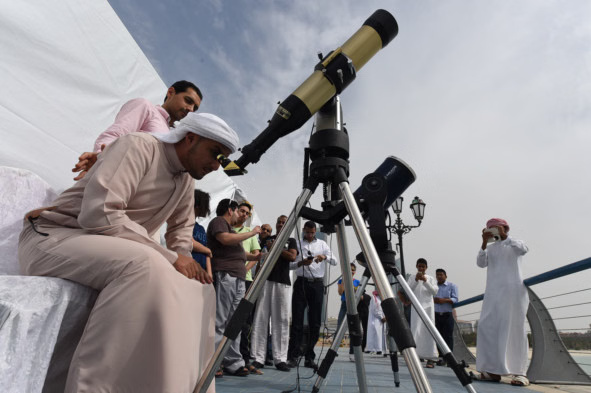
The International Astronomy Centre has successfully recorded a rare astronomical event in which a star disappeared for 38 seconds as it passed behind the dwarf planet Haumea, marking a significant milestone in the region’s growing contribution to global space research.
Engineer Mohammed Shawkat Odeh said the Al Khatim Astronomical Observatory documented the phenomenon on Monday evening, capturing what is known as a stellar occultation — when a celestial body passes in front of a distant star, temporarily blocking its light.
The event is considered scientifically significant, as Haumea — which orbits the Sun beyond Neptune near Pluto — is known to have two moons and a ring system. Observations of stellar occultation offer rare opportunities to study these features in detail, including refining measurements of the planet’s size, orbit and potential atmosphere.
The observation was part of a coordinated international campaign involving 106 observers, most of them based in Europe. From the Arab world, five observatories took part, including two in the United Arab Emirates.
Preliminary data showed that only four observatories worldwide successfully recorded the event, including two in the Arab region — the Al Khatim Astronomical Observatory and the Al Amri Astronomical Observatory — underscoring the advanced capabilities of regional facilities.
The UAE-based observatory used a 14-inch telescope equipped with a high-sensitivity astronomical camera to capture the event. To ensure precise timing, which is critical in such observations, a specialised astronomical timing device linked to satellite signals was deployed, enabling measurements accurate to within one-thousandth of a second.
Mohammed Shawkat Odeh said the observatory has submitted its findings to relevant international bodies for further analysis.

