

DMCC drives transformation of Dubai’s southern corridor with next-generation landmarks.
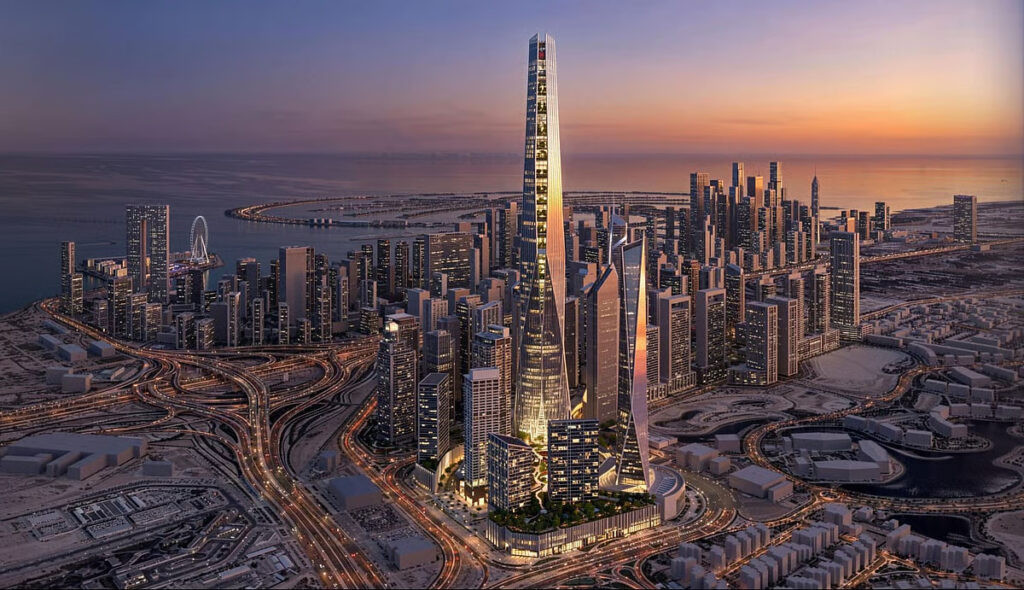
Following the recent unveiling of details about the 600-metre-plus megatall skyscraper in the Uptown Dubai district, a clearer picture is emerging of Dubai Multi Commodities Centre (DMCC)’s distinctive development philosophy. At a time when global real estate markets often shift with geopolitical currents, Dubai Multi Commodities Centre (DMCC) has built a reputation for resilience through a self-funded, demand-driven strategy—transforming Dubai’s southern corridor into a global powerhouse.
The origins of this success story trace back to a bold financial move that set the tone for decades to come. While many developers rely heavily on traditional bank financing, Dubai Multi Commodities Centre (DMCC) powered its foundational infrastructure through a landmark $200 million sukuk. These proceeds were strategically invested in constructing the district’s architectural anchors—Almas, Gold, and Silver Towers.
The market’s response to this vision was both immediate and historic. Almas Tower—the world’s tallest diamond-focused commercial tower—designed by WS Atkins & Partners Overseas and built between 2005 and 2008 through a joint venture between Taisei Corporation and Arabian Construction Company (ACC), sold out to end users, primarily diamond companies, in just eight hours. This remarkable achievement remains a benchmark for real estate velocity in the region.
Financed by a consortium of banks including Mashreq, HSBC, Emirates NBD, and Standard Chartered, Almas Tower’s early success demonstrated that Dubai Multi Commodities Centre (DMCC) was not merely developing office space, but creating a specialised ecosystem for global trade.
“From the very beginning, our mandate was to create an environment where trade could flourish,” says Ahmed Bin Sulayem. “From its earliest stages, Almas Tower was a statement of intent. By self-funding our core infrastructure, we retained the agility to move at the speed of global business, ensuring that we delivered what the market needed, exactly when it was needed.”
This resilience was tested again during the 2008 global financial crisis. While much of the world pulled back, Dubai Multi Commodities Centre (DMCC) pressed forward with the support of Dubai Islamic Bank, developing One JLT—a design-build, LEED Gold-accredited premium commercial building designed by Arif & Bintoak and constructed by Brookfield Multiplex. Despite widespread post-recession skepticism, the project broke ground in early 2014 and was fully handed over by 2016. It demonstrated that high-quality, sustainable office space would consistently attract tenants in a well-regulated, business-friendly environment. Even amid the global downturn, DMCC continued to expand its member base, reinforcing Dubai’s reputation as a stable platform for international trade.
The story of confidence continued with the master planning of the Uptown district. Launched and executed amid the post-Covid-19 economic recalibration, many analysts questioned the viability of major expansions along Dubai’s southern corridor. Yet, Dubai Multi Commodities Centre (DMCC) delivered the Uptown Tower—designed by Adrian Smith + Gordon Gill and built by BESIX between 2019 and 2023—financed once again by Dubai Islamic Bank, leveraging the success of One JLT. The tower’s swift uptake by global multinationals and luxury residents reinforced a fundamental truth: Dubai’s long-term growth trajectory is anchored in openness, stability, and global connectivity.
“We have always looked beyond the immediate horizon,” explains Ahmed Bin Sulayem. “When others saw risk in the post-Covid landscape, we saw an opportunity to redefine the workplace. Uptown Tower is a testament to our belief that if you provide world-class infrastructure and a seamless business environment, the world will come to you. We do not wait for demand to arrive; we build the catalysts that create it.”
As Dubai Multi Commodities Centre (DMCC) gears up for Phase 3 of the Uptown District, and with the free zone now home to over 26,000 companies, its strategy will once again rely on a hybrid financing model through multiple banks, particularly for the separate allocations of the mixed-use megatall tower.
Tokenisation of property
DMCC is also exploring property tokenisation to enable fractional ownership and digital investment in real estate—mirroring the transparency and liquidity it has long provided in the gold and silver markets. By tokenising property, DMCC aims to lower the barrier to entry for international investors, allowing them to participate in Dubai’s real estate growth with the same ease as trading a commodity. This forward-looking approach positions the district at the forefront of the Web3 economy.
DMCC’s ongoing self-funded model ensures resilience against external credit cycles, enabling profits to be reinvested into the next generation of supertall landmarks and digital trade corridors. It also provides greater flexibility in how assets are managed, leased, or potentially sold.
“Our strategy has never been about following trends, but about setting them and understanding where the customer and market are headed,” adds Ahmed Bin Sulayem. “Whether it is building the tallest commercial tower or tokenising the floors within it, our goal remains the same—to maximise opportunities for our members.”
As Phase 3 approaches, global attention is increasingly focused on Dubai’s southern corridor, where a fusion of architectural ambition and digital innovation showcases that, in Dubai, confidence in the future remains the city’s most powerful asset. For DMCC, that confidence is reflected in its ability to continuously and autonomously shape its own destiny within the context of Dubai’s limitless growth.

