

The deployment of the elite 82nd Airborne increases military pressure on Iran even as signs emerge of possible diplomatic talks.
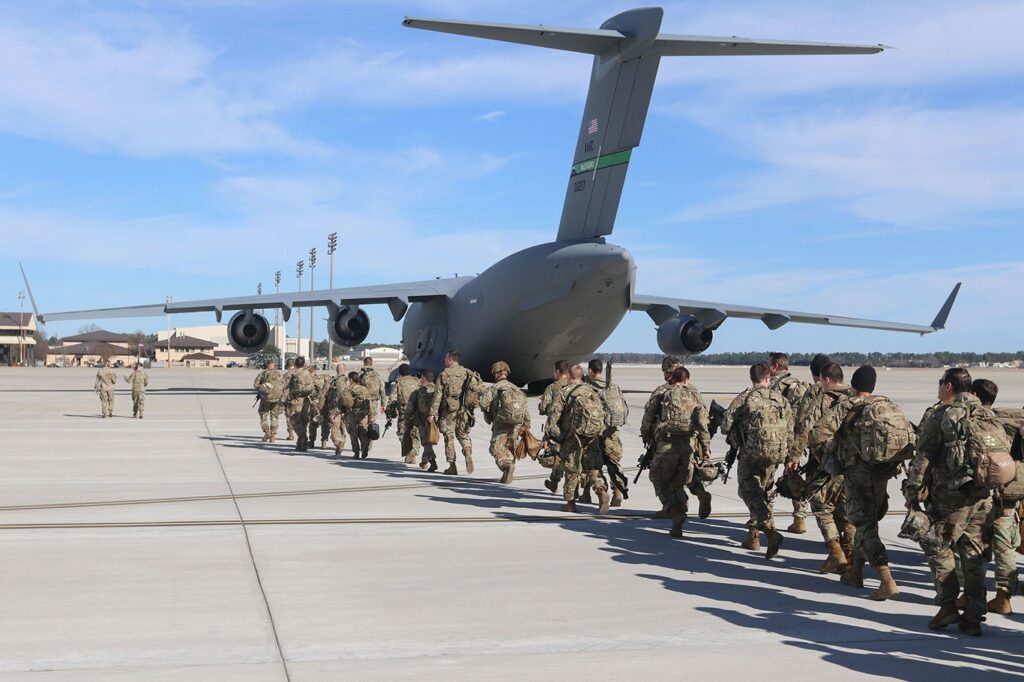
The United States is preparing to deploy elite airborne troops to the Middle East, signaling a new escalation in its military stance amid the ongoing conflict with Iran.
At least 1,000, and possibly up to 2,000, soldiers from the Army’s 82nd Airborne Division are expected to head to the region in the coming days, joining thousands of Marines already on the move.
The deployment comes even as Washington suggests that diplomatic efforts may be underway, reflecting a dual strategy of increased military pressure alongside potential negotiations.
The United States is deploying soldiers from the 82nd Airborne Division, one of the Army’s premier rapid-response units, trained to deploy quickly anywhere in the world for combat or crisis operations. These troops are highly mobile, capable of parachute insertion, and often serve in missions that require immediate military presence.
The deployment will consist of a battalion from the 1st Brigade Combat Team of the 82nd Airborne Division, accompanied by Maj. Gen. Brandon Tegtmeier, the division’s commander, along with key elements of his headquarters staff. This ensures both combat capability and command oversight are in place for the mission.
The 82nd Airborne unit being sent is designed for rapid global deployment, often tasked with high-risk or time-sensitive missions. Initial plans call for at least 1,000 troops, though the total could increase to around 2,000 as the deployment is finalized.
Including the Marines already deployed, the total number of additional U.S. ground forces sent to the region since the conflict began is approaching 7,000.
Overall U.S. Presence: About 50,000 U.S. personnel are currently assigned to operations linked to the conflict.
Key Takeaways:
- Up to 2,000 U.S. airborne troops set for deployment
- Part of a wider 7,000-strong troop buildup
- Total U.S. forces in the region: ~50,000
- Marines likely to lead initial operations
- Airborne troops provide rapid reinforcement capability
- U.S. signals diplomatic negotiations even as military pressure rises
- Iran denies direct talks and signals continued resistance
Why Deploy Airborne Troops?
Airborne forces offer speed and flexibility, capable of quickly securing key locations such as airfields, ports, or strategic infrastructure. In this deployment, planners are considering scenarios that could involve securing sites like Kharg Island, Iran’s main oil export hub.
Objective of Operations:
The airborne deployment could aim to disrupt Iran’s energy exports and increase pressure on Tehran.
Role of the Marines:
- Initial operations are expected to be led by Marines.
- About 5,000 Marines and sailors from two expeditionary units are already moving into the region.
- Marine combat engineers may be tasked with repairing damaged infrastructure, such as airfields on Kharg Island, to support follow-on deployments.
How the Operation Could Work on the Ground:
- Military planners are considering a phased approach.
- Marines could lead the initial assault and stabilization, including repairing infrastructure such as airfields.
- Once conditions allow, airborne troops would deploy to reinforce positions and expand operations.
- Paratroopers arrive quickly but generally do not carry heavy armor, making coordination with other forces crucial.
- The deployment signals a clear military escalation, even as Washington emphasizes that diplomacy remains an option.
U.S. Position on Negotiations:
President Donald Trump stated the U.S. is “in negotiations right now,” adding, “We have a number of people doing it. And the other side… they’d like to make a deal.”
Iran’s Response:
- Iranian officials have disputed claims of direct talks with the U.S.
- While Foreign Minister Abbas Araghchi has engaged in discussions with international counterparts, Iran’s parliament speaker denied that negotiations with the U.S. are underway.
- A military spokesman vowed to continue fighting “until complete victory.”
Potential Troop Positions:
Officials have not confirmed specific locations, but U.S. forces are expected to be positioned within operational range of Iran.
Potential Missions:
The deployment could involve securing strategic sites or supporting maritime operations related to the Strait of Hormuz, a key chokepoint for global oil shipments.
Next Steps:
- U.S. lawmakers are expected to receive classified briefings on the deployment, indicating that decisions on troop use are still evolving.
- The situation remains fluid, with both military and diplomatic efforts ongoing.

