

Many arrive carrying the stress and speed of the outside world in their nervous system.
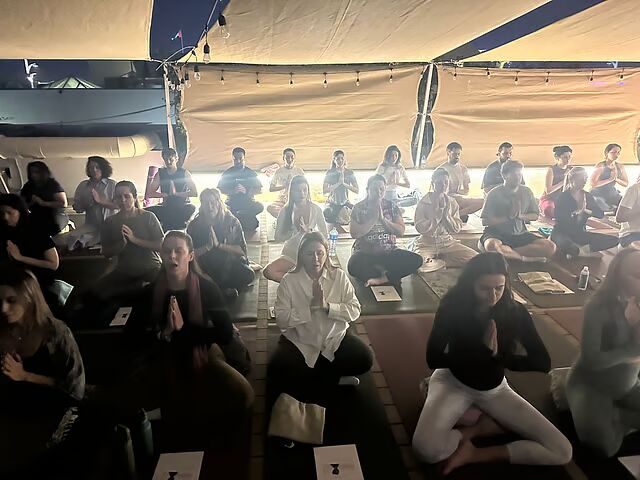
March has been relentless. As tensions ripple across the Middle East, many are finding it difficult to pause or even catch their breath. Yet, in a world that refuses to slow down, some communities are intentionally carving out moments of calm. In the Jumeirah neighbourhood, a small evening ritual has begun to take shape. Over the past week, residents have been gathering for something deceptively simple: to breathe, stretch, sit, and share food.
Some arrive straight from work, shoulders tense from the day. Others come after iftar during Ramadan, seeking a few moments of calm before returning to the rhythm of family life. The gatherings are informal and gentle, blending yoga, meditation, and conversation, allowing neighbours to reconnect during a time when many feel unsettled by the news.
The setting for these evenings is SEVA Experience, a wellness space nestled within a illa garden. But regulars say the focus isn’t the venue itself—it’s the sense of community that emerges when people slow down together.
For Shadi Enbashi, co-founder of the space, the gatherings are about helping people reset their internal rhythm..
“People often arrive with the fast pace of the outside world embedded in their nervous system,” he explains. “What we do here is help them reset and reorganize that rhythm, so they can face reality with greater clarity, rather than merely trying to escape it.”
Slowing the nervous system
The evening sessions blend breathwork, meditation, gentle movement, and sound-based practices aimed at calming an overstimulated mind. In Kundalini yoga classes, participants move through simple sequences called kriyas—precise combinations of breath, posture, and rhythm, as Enbashi explains. “In Kundalini Yoga, for example, these kriyas use breath, posture, and rhythm to shift the state of the nervous system.”
For many attendees, the effect is immediately noticeable. “The mind becomes less fragmented. Attention returns to the body. Many people report leaving with a sense of internal order and calm that was missing when they arrived.”
The focus is less on chasing relaxation and more on creating coherence.
Open to beginners
Despite the yoga mats and meditation cushions, the gatherings are not limited to experienced practitioners. Many participants are simply curious neighbours exploring something new.
“One of the most common misconceptions about yoga and meditation is that you need experience or flexibility,” Enbashi explains. “In reality, these practices were designed to be accessible to ordinary people living ordinary lives.”
Beginners often start with the basics: conscious breathing, a few minutes of quiet sitting, or gentle movements that reconnect the body and breath.
The classes and experiences are structured so that first-time participants can engage comfortably from the start, he says. “Each session meets people where they are. A newcomer and an experienced practitioner can share the same class and each receive what they need.”
As Enbashi emphasizes, consistency is far more important than complexity.
Why calm isn’t just psychological
For many trying to manage stress, the instinct is to force calm through positive thinking. But Enbashi explains that the body often needs to take the lead. “Calm is often misunderstood as something we should achieve mentally—through willpower or positive thinking,” he says. “In reality, calm is physiological.”
Constant exposure to uncertainty, fast-moving information, and alarming headlines can push the nervous system into a heightened state of alertness.
“The mind alone cannot override it,” he explains.
Instead, the body requires clear signals that it is safe to slow down: deeper breathing, quieter environments, and slower, more deliberate movement.
“The way back is through the body—slowing the breath, moving with intention, carving out small moments of the day with less noise and stimulation, and spending time in environments that allow the nervous system to reset,” Enbashi says.
“Practices like meditation, breathwork, and yoga are essentially tools for regulating the nervous system. They help people stay steady even when the external environment is chaotic.”
A moment of stillness
In a city like Dubai, where life often moves at breakneck speed, the appeal of these small neighbourhood gatherings is easy to see.
After the sessions conclude, many participants linger. Some sit quietly in the garden for a few extra minutes, while others share a meal together, continuing conversations that began on their yoga mats.
“The way back is through the body—slowing the breath, moving with intention, carving out small moments during the day with less noise and stimulation, and spending time in environments that allow the nervous system to reset,” Enbashi explains.
“Practices such as meditation, breathwork, and yoga are essentially tools for regulating the nervous system. They help people stay grounded even when the external environment is chaotic.”
A moment of stillness
In a city like Dubai, where life often moves at breakneck speed, the appeal of these small neighbourhood gatherings is easy to grasp.
After the sessions conclude, many participants linger. Some sit quietly in the garden for a few extra minutes, while others share a meal, continuing conversations that began on their yoga mats.

