

Travel across the GCC has typically required several rounds of passport control and security screening.
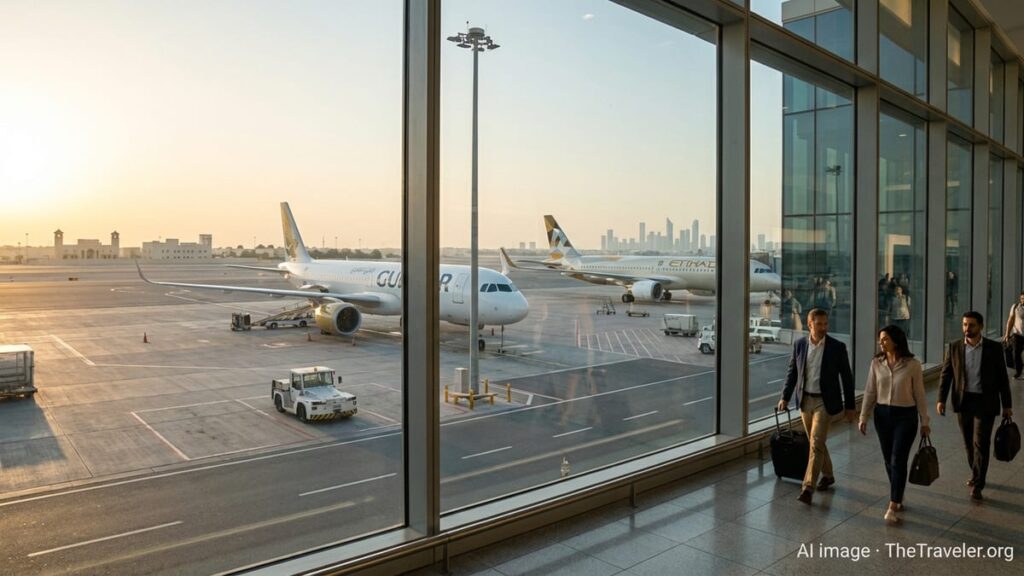
Dubai: With a new travel pilot between the United Arab Emirates and Bahrain now underway, short-haul regional travel is beginning to see a notable shift. While the immediate emphasis is on faster airport processing, the initiative is part of a broader, long-term effort to rethink how border procedures are coordinated across Gulf Cooperation Council member states.
1. Avoids duplication that long slowed travel
Travel between Gulf countries has traditionally involved multiple layers of passport and security checks, even on flights lasting less than an hour. Passengers typically clear formalities before departure and repeat much of the process upon arrival — a system that often creates congestion, particularly during peak travel periods.
The United Arab Emirates–Bahrain pilot aims to eliminate that duplication by consolidating checks into a single stage. This approach reduces the operational burden at arrival airports while maintaining existing travel eligibility rules.
2. Border clearance shifted to departure stage
Under the pilot between the United Arab Emirates and Bahrain, eligible travellers complete immigration, security screening, and biometric verification at their departure airport rather than at their destination. Once these checks are finalised and digitally verified, passengers are treated as pre-cleared upon arrival.
This model mirrors pre-clearance systems used in select international travel corridors, relying on trusted, shared digital frameworks instead of repeated physical inspections at each border point.
3. Two airports acting as test beds
The trial is currently being implemented at Zayed International Airport and Bahrain International Airport, both of which handle significant short-haul traffic between the two countries. These airports were selected to assess whether the model can operate efficiently under real-world passenger volumes and operational pressures.
Behind the scenes, immigration and security systems in both countries exchange passenger data in real time, enabling authorities to verify eligibility and security status before travellers board their flights.
4. Tech-enabled system aided by coordination
The pilot is supported by biometric verification, e-gates, and secure passenger-data platforms, which ensure that identity checks are accurate and consistently applied across borders. These technologies enable authorities to rely on digital verification rather than repeated physical inspections at multiple stages of the journey, streamlining the travel experience while maintaining security standards.
4. Tech-enabled system aided by coordination
The pilot relies on biometric verification, e-gates, and secure passenger-data platforms, ensuring identity checks are accurate and consistent across borders. Beyond the technology, the initiative depends on close coordination between border agencies in the UAE and Bahrain, as well as cooperation from airlines participating in the trial, helping integrate the process seamlessly into existing airport operations.
5. GCC residents see immediate practical perks
For GCC nationals travelling between the UAE and Bahrain, the most tangible benefit is reduced time at arrival checkpoints. Short business trips become more predictable, and peak-hour congestion at arrival halls is eased as fewer passengers require full immigration processing. Officials note that these early improvements serve as a test case, with the long-term goal of extending similar systems to other intra-GCC routes if the pilot proves reliable and scalable.
6. Tourists unaffected for now, larger changes expected
The single travel point pilot does not change visa requirements or entry eligibility for international visitors, who continue to follow existing arrival procedures. Its immediate relevance to tourists is limited, but it signals potential future regional integration that could streamline travel for all GCC routes over time.
7. Looking ahead: Unified GCC Visa
The next major step is the planned Unified GCC Visa, expected around 2026. This initiative would allow visitors to enter all six GCC countries with a single permit, significantly simplifying multi-country itineraries and making regional travel more seamless.

