

Shaikha Al Ketbi and Mohamad Kazem dazzle at major Seoul exhibition
In a landmark cultural milestone, the UAE’s contemporary art scene is making a strong impression in South Korea.
Proximities, organised by the Abu Dhabi Music & Arts Foundation (ADMAF) in partnership with the Seoul Museum of Art (SeMA), is the largest exhibition of UAE contemporary visual art ever held in Korea.
Running until February 22, the exhibition features over 80 works by 46 artists, spanning photography, video, sculpture, performance, and installation. Co-curated by Maya El Khalil and Eunju Kim, the show examines how “proximity” — emotional, geographic, and cultural — shapes artistic meaning across generations and regions.
At its heart, Proximities showcases a UAE art scene that is both experimental and globally resonant, a vision reflected in the works of Emirati artists Shaikha Al Ketbi and Mohamad Kazem.
Ritual, Play, Perception
UAE artists captivate Korea with ‘Proximities’: “Emirati art resonates globally”
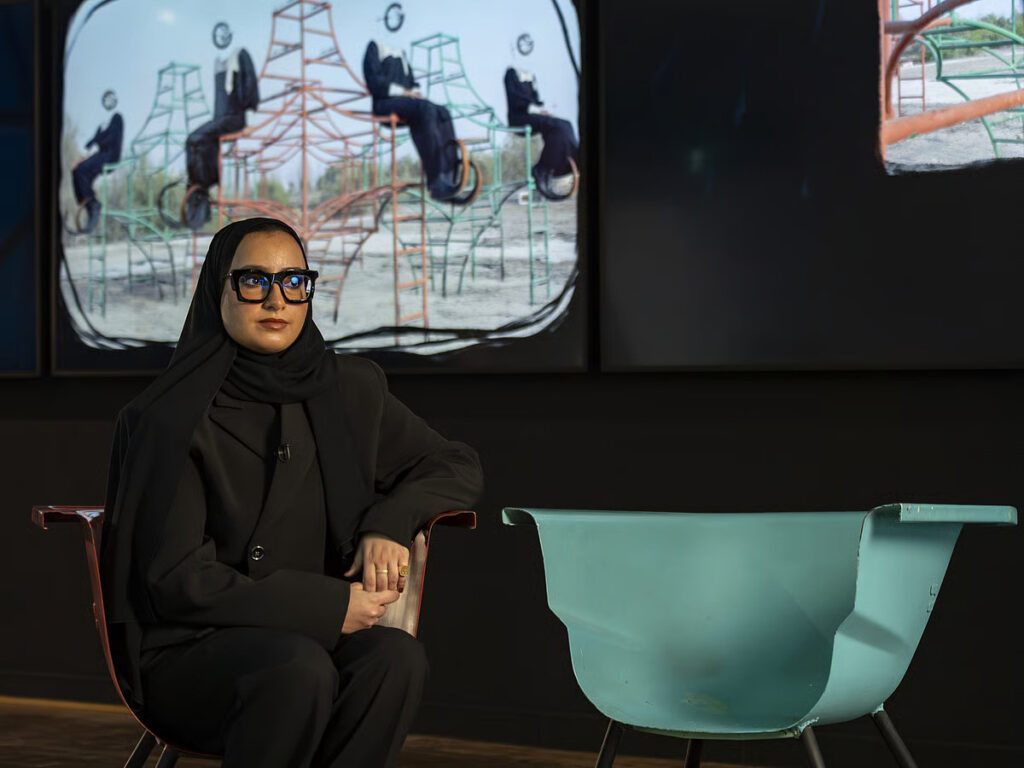
For Abu Dhabi-based Shaikha Al Ketbi, Seoul marks the first time several of her works have been presented in conversation. Her video installations Sigh (2019) and al Ukhra (2019) unfold like poetic fables, inviting viewers into layered narratives of ritual and perception.
A mysterious figure seems to have descended from outer space into a desert bathtub, then traverses an abandoned playground, performing subtle rituals in response to her environment. The works explore the delicate interplay of balance, fragility, and adaptation within landscapes that shift between the familiar and the surreal.
“These works can be seen as a two-part video installation,” Al Ketbi explained.
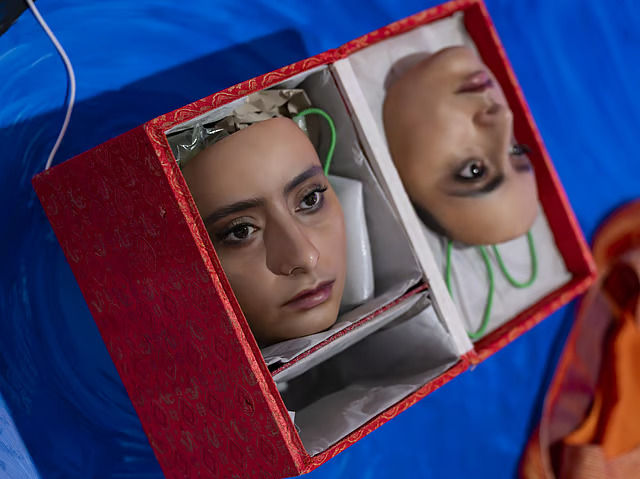
Her latest piece, Book (2024), filmed at Japan’s Site of Reversible Destiny, introduces a character wearing an upside-down mask — a replica of her own face. Set within an architectural space designed to disorient the senses, the work becomes a meditation on perception and multiplicity.
Heritage Reimagined
“The reception has been thoughtful and curious,” she said. “Exhibiting in Seoul reinforces how Emirati art is increasingly understood through its own specific vocabularies, rather than only through orientalist framing or questions of representation. The audience engages closely with details of texture, gesture, and spatial transformation, making the dialogue both generous and rigorous.”
For Al Ketbi, heritage is a living set of gestures and mythologies that can be reactivated. “The balance comes from allowing tradition to behave unpredictably, and letting experimentation remain grounded in memory, humour, and the everyday,” she added.
Labour, Erasure, and Environment
UAE artists captivate Korea with ‘Proximities’: “Emirati art resonates globally”
While Shaikha Al Ketbi navigates dreamlike landscapes, Mohamad Kazem grounds his practice in the observation of lived realities. The Dubai-based artist presents Window (2002–2003) and Directions (Merging) (2022). Though separated by two decades and distinct media, both works explore how human presence is inscribed in the environment, and how these traces are revealed or erased.
Window combines video, documentary photography, and text to investigate what lies behind architectural development: labour, hierarchy, and social invisibility. By contrast, Directions (Merging) observes engraved coordinates gradually erased by the sea — a reflection on impermanence and human intervention.
“The response has been attentive and thoughtful,” Kazem said.
Beyond Identity Narratives
Viewers engaged with themes of labour, erasure, and environmental change “without the need for cultural explanation,” Kazem noted.
“Emirati art can resonate internationally when it speaks to lived conditions and shared human experiences rather than relying on identity-based narratives,” he said.
Focusing on social structures and transformations in his surroundings, Kazem describes experimentation as “a way of responding to reality.”
For both Al Ketbi and Kazem, exhibiting in Seoul underscores a growing confidence in the UAE’s artistic voice — one that speaks not only of place, but of universal human conditions.

