

Moon World Resorts founders set the record straight on Dubai buzz, schedules, and progress.
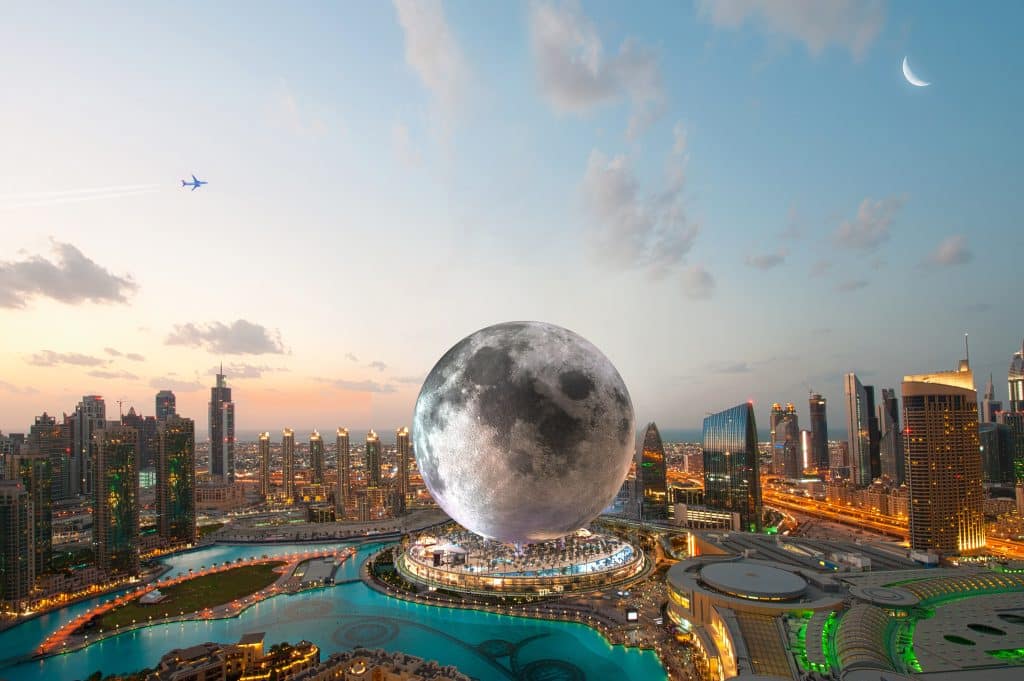
Dubai: Every few months, speculation resurfaces about an ambitious concept linked to the city—a $5 billion (Dh18.5 billion) mixed-use development shaped like the Moon. Social media often fuels the buzz, suggesting locations and launch dates with striking certainty. The idea first gained attention in 2022, when Moon World Resorts outlined its plans in UAE media. Since then, the question has persisted: Is Moon Dubai actually happening, or is it destined to remain a viral concept?
To clarify, We spoke directly to Michael R. Henderson and Sandra G. Matthews, co-founders of Moon World Resorts Inc., about the project.
What Moon actually is
At its core, Moon is envisioned as a mass-tourism development built around a central spherical structure. “It’s basically a mass volume touristic development,” Henderson explained, describing a master plan with three components. The centerpiece is the Moon sphere itself, which he described as “the largest sphere in the world. It’s a true sphere—you can actually walk underneath it. It’s not a dome.”
Inside the structure will be a fully integrated destination resort. Convention and event centers, wellness and longevity facilities, hotels, lounges, and restaurants form the familiar framework—but Henderson emphasizes that “everything inside our project will be totally different.”
What sets Moon apart is its signature attraction: a lunar surface and lunar base. “This is totally unique in the world. Nothing remotely similar,” Henderson said. Visitors will be able to walk on a simulated lunar surface and explore a lunar base. “We’re not a theme park. It’s an adult-oriented facility,” he added, noting the space would also host space training and space tourism experiences.
Surrounding the central Moon sphere is a large lagoon and park, reflecting the founders’ emphasis on environmental sustainability. Beyond that, a ring of branded luxury residences is planned. “We have 10,000 residential units surrounding the project,” Henderson said. “From a bird’s-eye view, it’s essentially a smart mini-city that delivers a full work-live-play experience.”
Why Dubai keeps coming up
Interest in Dubai has intensified, largely driven by social media. Henderson acknowledged the benefits—and drawbacks—of the viral attention. “Our project has gone viral three times. Moon is currently the most talked-about project on the planet,” he said. Yet, he cautioned, “the facts are not always correct.”
Moon World Resorts operates as a design studio and intellectual property licensor, headquartered in Canada. Its role is not to build directly, but to license up to ten Moon projects worldwide, spanning Latin America, North America, Europe, Asia, Oceania, and the Middle East.
“The Middle East will definitely have a Moon,” Henderson confirmed. The exact location depends on government support and a regional development partner, noting, “For a project of this scale, you need a government involved.”
Dubai’s appeal, he explained, stems from a convergence of factors: rising global interest in space tourism, the city’s instantly recognisable brand, and Moon’s universal symbolism. “Eight billion people know our brand,” Henderson said. “Combine that, and it makes sense.”
UAE versus the region
Speculation often includes Saudi Arabia, but Henderson ruled it out due to feasibility challenges. Bahrain and Oman could work partially, while Qatar is a strong contender. Still, he argued, the UAE stands apart, thanks to infrastructure, airlift capacity, and tourism volume—all crucial for Moon’s success.
Matthews emphasized that Moon is not intended as a white-elephant project. “It will create jobs across tourism, construction, science, education, wellness, and longevity,” she said. “The experience itself is transformative. When an astronaut walks on it, they’re going to be wowed.”
Timelines, pricing, and realism
Rumours of a Dubai launch in 2027 are off the mark, Henderson said. A more realistic timeline places the first Moon opening around 2032, assuming construction begins in 2027. “It’s about a four- to five-year build-out, typical for a project of this size,” he explained. After the first Moon is completed, replication becomes easier, with projects sharing roughly 95% of their design.
Moon aims to make space tourism accessible. The signature lunar surface experience is priced at $500 for 90 minutes, comparable to a ticket for a major rock concert. “We can accommodate 2.5 million visitors on our lunar surface each year,” Henderson said.
Hotels within Moon include a 4,000-suite five-star property offering competitive rates and a 200-room boutique hotel at a premium price point.
Why local developers are selective
Despite the buzz, Moon has not yet secured a regional development partner. Henderson explained that most local developers focus on short-term, quick-turnover residential projects, whereas Moon is a long-term tourism asset.
Only a handful of developers have the scale and mandate to make it work. “Basically two developers could make Moon happen: Emaar, because Mohamed Alabbar is the best developer in the world, and Aldar in Abu Dhabi,” he said, noting Qatari Diar as another government-linked possibility.
So, is Moon Dubai happening?
For now, the outcome is still unfolding. Moon will come to the Middle East, the UAE fits the project’s requirements on paper, and Dubai aligns with the narrative the public already believes.

